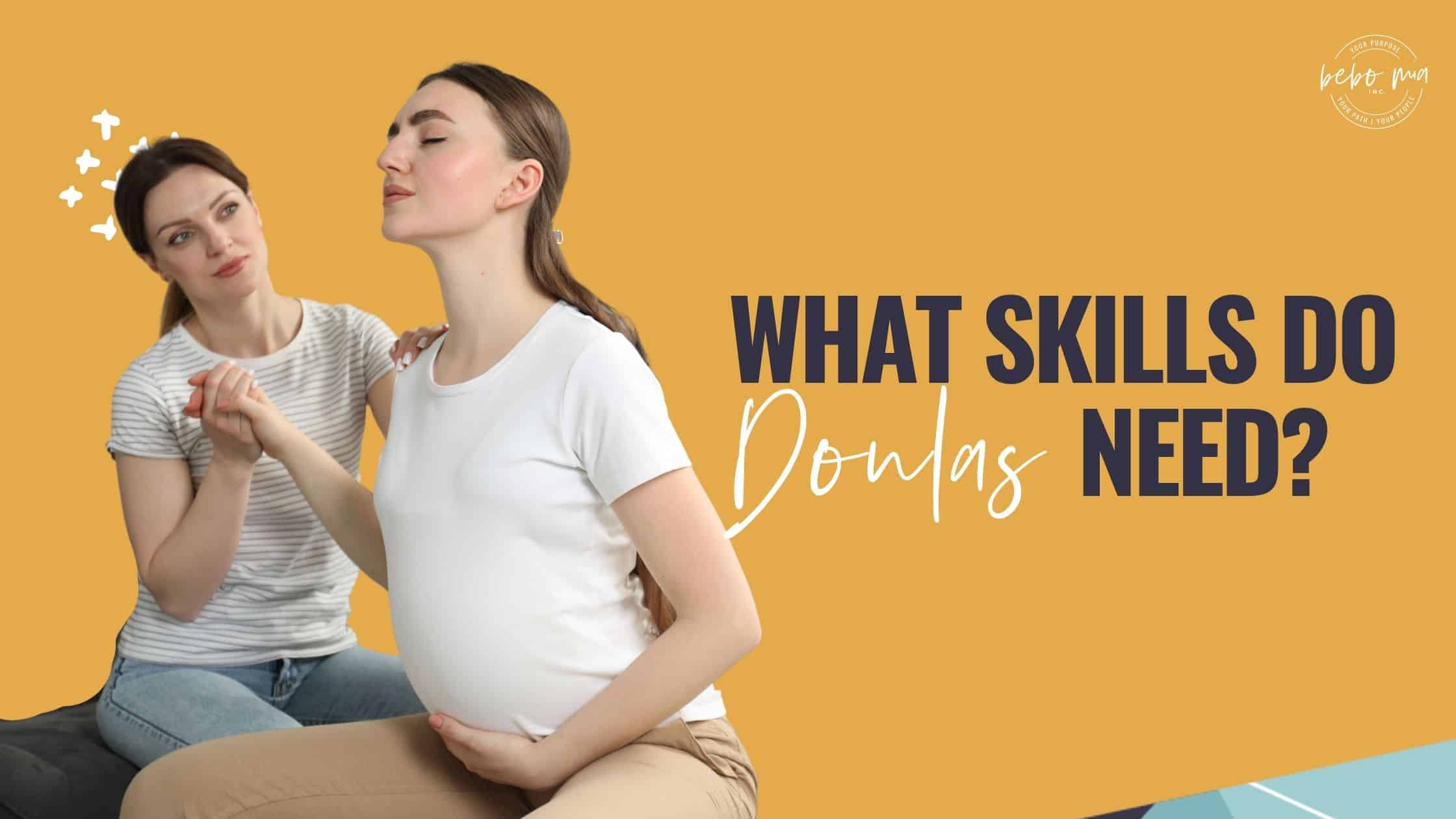
We LOVE talking to our potential students! And last week Bianca, the bebo mia founder, had just logged into the free career strategy calls (FYI: book yours here if you want to jump on that!). After the hellos this gal asked, ‘what skills do I need to be a doula?’ In 18 years of doing this, that was the first time we had been asked that in this way. It is a great question, so immediately we took it to the blog!
We know that when you are dreaming of a new career, you want to explore all the angles before you take the leap… so, this is probably one of the many questions rattling around in your brain. Do I have what it takes? Am I the right kind of person for this? What do I even need to know?
Good news: most people who are genuinely drawn to doula work already have more of the foundational skills than they realize. The rest is learnable. That is actually what a really good in person or online doula training is for.
Here is the honest breakdown…
The skills you probably already have to be a good doula
- Being a genuinely good listener is the number one skill doulas need
Not the kind of listening where you are waiting for your turn to talk. The kind where you are fully present, tracking what is being said and what is not being said, noticing the shift in someone’s breathing or the way they looked away when they answered that question. This is the skill that makes families feel safe with you, and you cannot fake it.
If you are the person everyone calls when something hard is happening, if people consistently tell you they feel heard around you, you already have this.
(ProTip: Annnnnd if you are the type that waits for people to stop talking so that you can say your thing, we will help you with that in our live online doula training)
- Staying calm under pressure
Birth is unpredictable to say the least. Plans change. It is deeply emotional for everyone in the space. Providers say things that catch everyone off guard. A doula who gets rattled in those moments is not able to do their job effectively. The families you support are reading your body language and your energy constantly. You are the rock that folks co-regulate with.
Since you are not a robot, this is a skill you can learn… to feel it, then get grounded, and continue support. This does not mean you feel nothing. It means you have learned, (or are learning), to regulate your own nervous system while holding space for someone else’s. We talk about how doulas build and protect this skill here.

- Reading a room
Walking into a birth space (or postpartum space) and immediately understanding the energy, who needs what, what the tension is about, whether this provider is going to be collaborative or difficult, whether your client needs you close or needs you to step back. This is a skill that is partly innate and partly developed through experience. If you have worked in caregiving, teaching, social work, or any role where you had to quickly assess what a situation needed, you are already building this. Hello, parenting or community care requires this every darn day, so you are building that if you have littles in your world.
- Genuine warmth and non-judgment
Families come to birth with fear, baggage, complicated relationships, strong opinions, and sometimes choices you personally would not make. A doula’s job is not to agree with everything or to advocate for a particular kind of birth. It is to support the person in front of them in having the birth they want. That requires a genuine capacity to set your own stuff down at the door.
This is also why we cover the intersectionality of birth so deeply in our online doula training. The families you serve will be diverse in every possible way and your warmth and non-judgmental care needs to extend across all of it.
The skills you will build in your doula training
- Evidence-based knowledge of birth
You do not need to arrive at doula training already knowing the research. You need to be willing to learn it and keep learning it. Birth guidelines change and research is regularly released. What was considered standard practice five years ago may now be contradicted by the evidence. A good birth doula is always a student. Getting your hands on great research is something that we teach in our live online doula training since TikTok is not always a credible source!
What should we be staying on top of? This includes understanding the physiology of labor, common interventions and their actual evidence base, comfort measures and why they work, and the difference between what is medically necessary and what is routine pressure. We talk about that last one a lot, check this out for more.
- Hands-on comfort skills
Counterpressure, position changes, the rebozo, water therapy, breathing techniques, TENS machine use. These are practical physical skills that you learn through practice and repetition. Nobody walks into their first training already knowing how to do double hip squeeze properly. You learn it, you practice it, you get feedback, and over time it becomes second nature.
Your body is one of your primary tools as a birth doula. Taking care of it matters. We talk about that here because you need to care for yourself while caring for others.
- Advocacy and communication skills
Knowing what to say and how to say it is a key skill you will learn in your in person or online doula training. This alone is definitely not something that you can learn in a weekend doula training, so please check this out if you are considering one of these trainings. You also need to be able to slow a room down, support your client in asking good questions, and help your client access information without overstepping your scope. This is a skill that takes practice because practice makes permanent! A good doula training will aid you in developing this because in the moment, under pressure, it is genuinely hard.
Scripted language helps enormously with communication skills. Knowing the phrases that work, the questions that create space, and the words that de-escalate rather than inflame. This is something we teach and practice in our full spectrum doula training because it is too important to leave to improvisation.
- Understanding scope of practice
This is one of the most important skills a birth doula needs and one of the most commonly skipped in short weekend doula trainings. Knowing exactly what you are there to do, and what you are not there to do, protects you, your clients, and your career.
A doula does not give medical advice. A doula does not perform clinical assessments. A doula does not make decisions for their client. Understanding these boundaries deeply is what allows you to work powerfully and safely within them. We don’t want you to feel constrained by them, they are there for a reason and we make sure you are crystal clear about this.
- Business and self-employment skills
When we jump into our free doula career strategy calls, there are always a lot of questions about finding clients and how do you know what to charge. Like a lot of these questions! And we have the same answer, we will make sure you are confident with this. We will also help you with writing contracts, asking for reviews, managing your schedule, knowing when to say no and so much more.
These are skills that determine whether doula work becomes a sustainable career or a short-lived experiment. Most people do not come to doula training already knowing how to run a small business and that is completely fine. What matters is that your training teaches it.
We talk about what you actually need to build a doula business here.
The doula skill nobody talks about enough: knowing how to take care of yourself
Birth work is emotionally and physically demanding. The doulas who last in this field for years and years are the ones who have systems for recovery, processing, and refilling. This is not a personality trait y’all! It is a skill you build intentionally and protect fiercely.
If you do not have this yet, that is okay. Building it is part of what good training and good community give you. But go in knowing it matters as much as anything else on this list. Most doulas do not last more than 2 years and this is why!

Do you have what it takes?
If you are still reading this, probably yes, babes.
The people who are drawn to this work are usually already living some version of it.
They are the ones people call for support and care and help navigating tricky spots in their lives.
They stay calm when others do not.
They genuinely care about what happens to families in the birth space and they cannot stop thinking about it.
The skills you do not have yet are learnable. That is the whole point of choosing a training that actually takes your preparation seriously.
Bianca, our founder, started with a ten day old baby, no money, no support system, and a weekend training that taught her almost nothing about running a business. She figured it out. And then she built a training so that nobody else would have to figure it out alone.
If you want to explore what comprehensive birth doula training looks like, our full spectrum doula training runs every March and September: https://bebomia.com/doulatraining
Already certified somewhere else and feeling like something is missing? The cert transfer program is here: https://bebomia.com/certtransfer/
And if you want to talk through whether you have what it takes with someone who genuinely loves this conversation, book a free doula career strategy session with our team.
You probably have more than you think.




FREE ONLINE MINI-COURSE
BLISS IN BUSINESS RETREAT
Your future is created by what you do today — that's why we created a completely FREE mindset mini-course to help doulas and birth workers find bliss in their business!