Evidence or Coercion?
The Birth Truth Tool for Doulas™
Sweet doula, you've heard it. It sounds medical. It sounds urgent. It sounds like truth. A lot of the time it isn't, and in that moment you're expected to know the difference.
"Your placenta is aging."
"Your baby isn't tolerating labor."
"We just want to make sure everyone goes home healthy."
You can feel it when something's off.
There's a moment, and if you've been in a birth space you know this moment, when the doctor walks in and says something and the whole vibe in the room changes.
Your client suddenly looks worried. You can feel their worry. What the provider is saying sounds real. Sounds clinical. Sounds urgent.
And you think your client is being coerced, or experiencing practice-based care rather than evidence-based care.
You're not sure what to say next, because what if you're wrong? What question do you ask, or encourage your client to ask, to preserve the working relationship?
So you go quiet, or worse, you agree with the provider when your client looks up at you with a scared face.


Later, on the way home, you replay that moment. Was that true? Was that necessary? Could I have said something? Did I fail my client?
We know the medical system isn't serving birth well right now. The outcomes have never been worse. It's so hard to catch the moments where harm is actually happening, and even harder to know how to stop it for your clients, or for the parents navigating it themselves.
So you carry that weight, birth after birth. It feels risky to speak up when you're scared of being responsible for something going wrong.
You care so deeply. You've been stuck in this cycle without a clear way out.
Now there is one.
No more...
- going quiet in the room
- guessing what to say
- replaying it on the drive home
- wondering if you should've spoken up
- flipping through old training notes
- googling it in the bathroom
Hear it. Check it. Say it.
Hear it
A provider says something that doesn't sit right.
Check it
Type exactly what they said into the tool, or tap the closest topic button.
Understand it
See instantly whether it's evidence based or a pressure tactic, with citations from your country's own guidelines.
Say it
Use ready made scripts to respond to the provider.
Here's what it looks like in the room
This phrase has no clinical information in it. "Baby isn't tolerating" should come with an exact fetal heart rate category, a specific strip pattern, and a timeframe. Without those numbers, it's not a clinical statement, it's a fear tactic. BMC Pregnancy (Reed et al. 2017) identified this exact type of language as a core theme in birth trauma descriptions.
Not supported by current evidence. Fentanyl crosses the placenta rapidly and is detected in cord blood within minutes, and bupivacaine crosses too. Research documents newborn effects including respiratory depression, altered feeding behavior, and drowsiness, particularly notable in the first hours when feeding establishment is critical.
You're not flipping through notes. You're not trying to remember a training. You're not googling in the bathroom. You have it right there.
Everything you need. Nothing you don't.
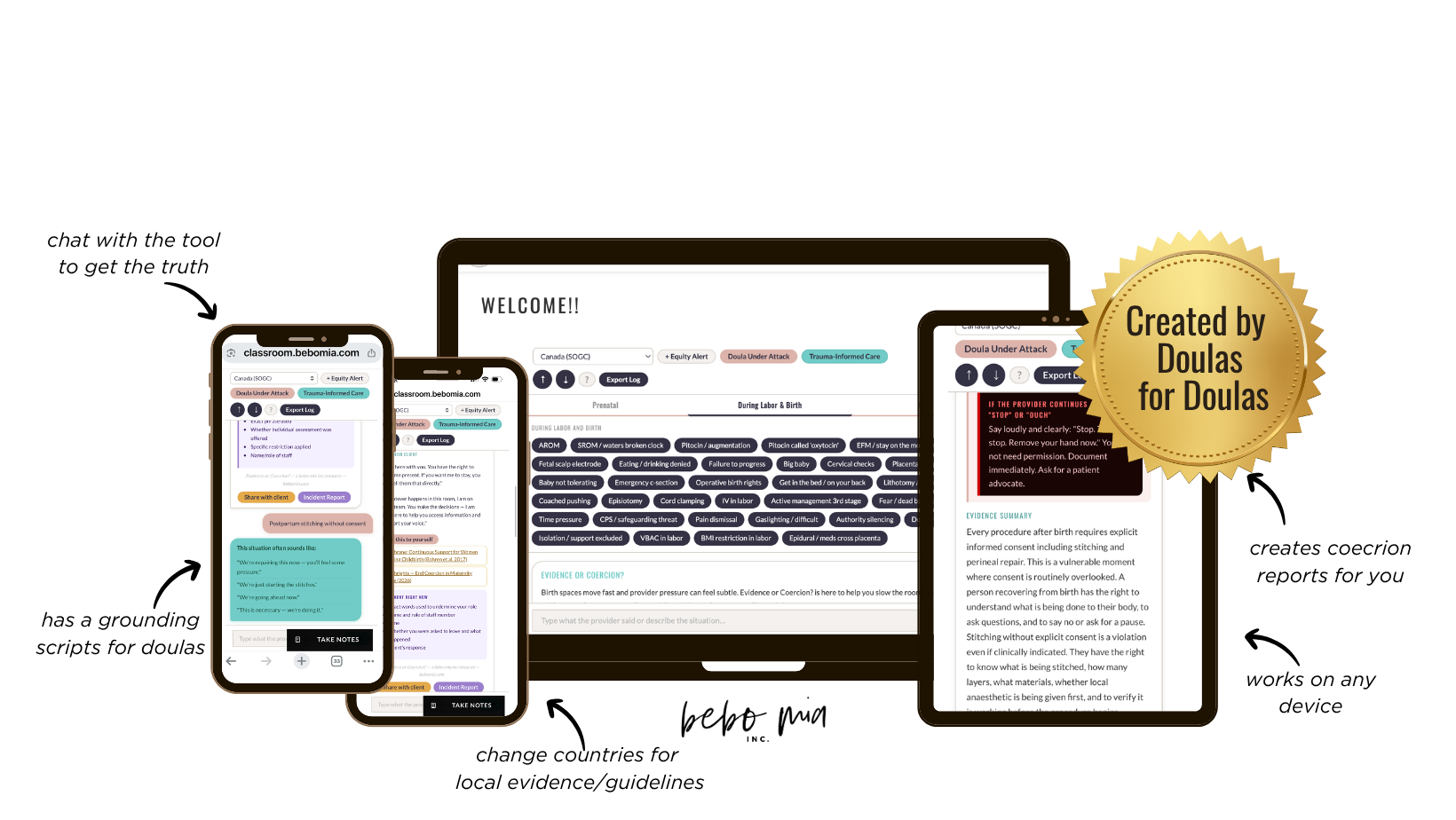
- 50+ topic buttons. Covers prenatal, labor and birth, after birth, and newborn consent.
- Type what the provider said. The tool identifies the coercion pattern and the level.
- Four alert levels. From subtle ethical fading to extreme psychological coercion.
- Evidence summaries with citations. Pulled from your country's own guidelines: Canada (SOGC), US (ACOG), UK (NICE/RCOG), Australia (RANZCOG), or International (WHO).
- Scripts for providers and for clients. Written in they/their/them throughout.
- Trauma informed guidance. Built into every relevant response, because we assume everyone walking into a birth space has a trauma history.
- Equity lens. 11 identity and experience tags, including BIPOC, Indigenous, Trans/Non-binary, Fat/Plus-size, Neurodivergent, and more.
- Doula Under Attack mode. For when a provider is undermining your role or asking you to leave.
- Incident Report. Documents exactly what happened and who to contact in your jurisdiction.
- Export Log. A timestamped record of every session, saved after each birth.
- Works offline. Desktop, laptop, or tablet. No app, no download.
"I highly recommend Evidence or Coercion? by bebo mia as a valuable addition to any birth doula's toolkit. This thoughtful and practical resource offers clear, evidence based information alongside useful, respectful language that can be shared with clients to help them ask specific questions of medical providers in real time."
This is the lowest Evidence or Coercion? will ever be. Beta access means you get the full tool, the bonus advocacy card, and a price that reflects that you're getting in early. When beta closes, it goes up and stays there.
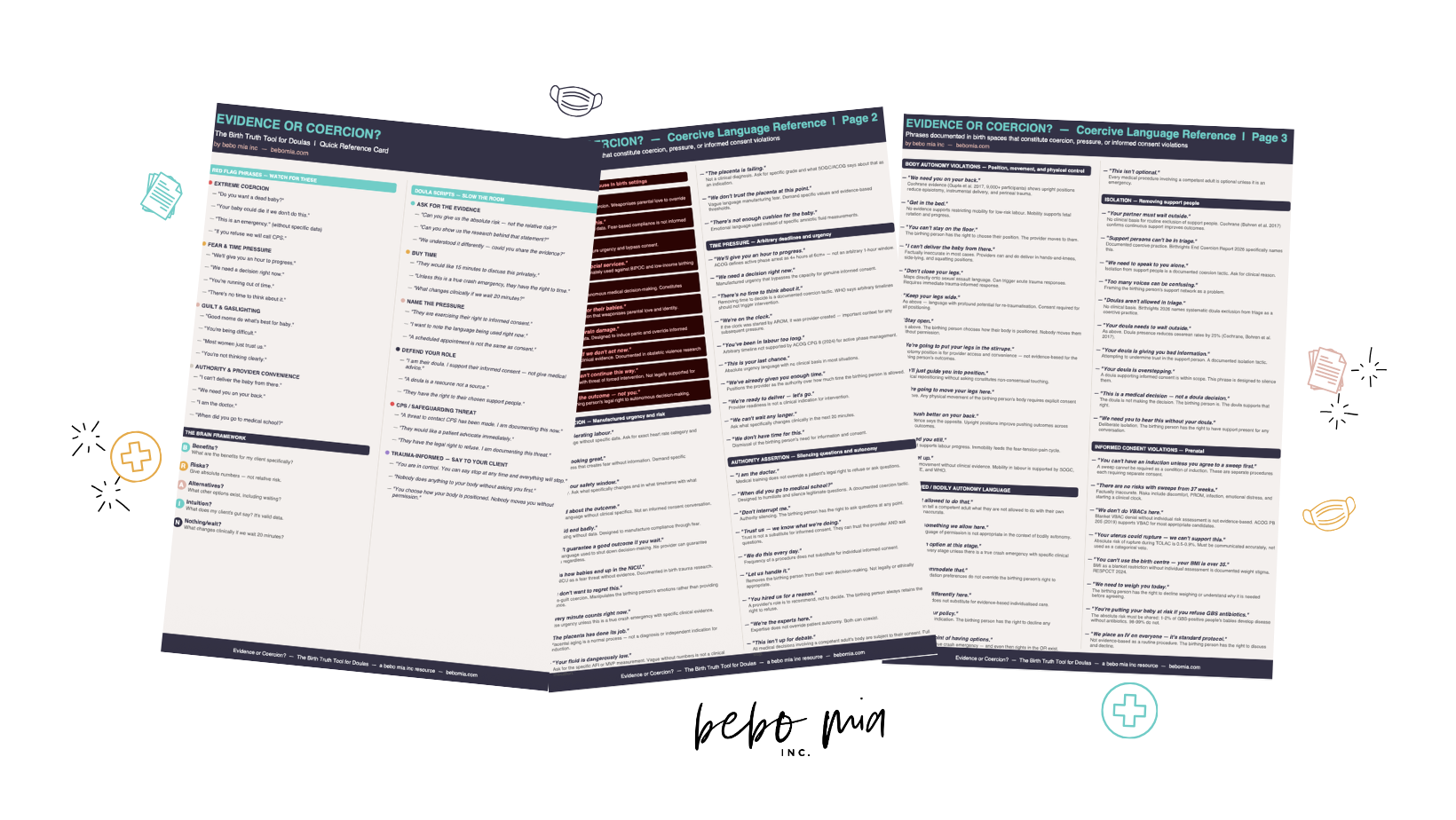
In the Moment Advocacy Card. Included free with beta access. A printable three page reference for your birth bag: 130+ documented coercive phrases, the BRAIN framework, and ready made scripts.
Tool guarantee
Take it into your next birth. If you don't feel more confident in the room, email us and we'll refund you. No questions. No hoops. We believe in this tool.

A note from Bianca
I've spent 20+ years in birthwork, and I founded the largest doula agency in Toronto before starting bebo mia. I built this because I watched too many brilliant doulas freeze in the exact moment their client needed them most. Not from lack of knowledge, but because the room moves fast and the pressure is real. This is the thing I wish I'd had, and honestly, parents in the room can lean on it too.
Questions, sweet doula?
Who is this for?
Birth and postpartum doulas who want to support their clients with trauma informed, evidence based care. Parents and birthing people can use it too, directly in the room.
Do I need an app or download?
No. It works right in your browser on desktop, laptop, or tablet, and it works offline, so it's ready even without signal in the room.
What if it isn't right for me?
Take it into your next birth. If you don't feel more confident in the room, email us and we'll refund you. No questions, no hoops.
Why is it discounted right now?
We're testing it and building in your feedback to make the tool even better. We're listening, so if you have notes or requests, let us know. You'll have every updated version of the tool for life.